If you have read our previous guide on building a data transformation roadmap, you know the principles: assess honestly, prioritize transparently, sequence realistically, and keep the roadmap alive. This article goes one level deeper. It provides a concrete, reusable digital transformation roadmap template, the structure, phases, milestones, and governance mechanisms you need to move from strategy document to executed reality.
Most roadmaps fail not because the strategy was wrong, but because the roadmap itself was poorly structured. It lacked clear phases. It did not account for dependencies. It had no governance rhythm. It confused aspirations with commitments. And when reality inevitably diverged from the plan, there was no mechanism for adaptation.
The template we present here is designed to avoid all of these failure modes. It has been refined through dozens of transformation programs across industries, from financial services to retail, from healthcare to industrial manufacturing. It is not theoretical. It is a working structure that you can adopt, adapt, and start using immediately.
The Template Structure: Five Phases
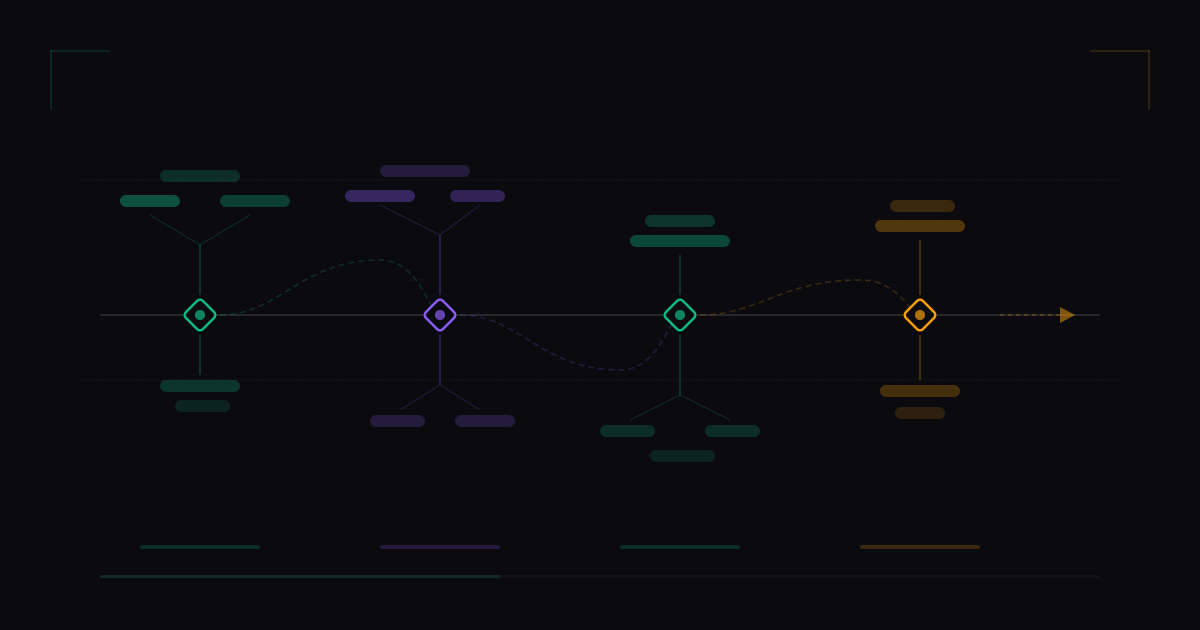
A well-designed digital transformation roadmap follows a five-phase structure. Each phase has a specific purpose, defined milestones, and clear exit criteria that determine when you are ready to move to the next phase. Skipping phases is the single most common cause of transformation failure.
Phase 0: Assessment and Alignment (Weeks 1-6)
Before you plan, you must know where you stand. Phase 0 is dedicated to understanding your current state and aligning stakeholders on the direction.
Key activities:
- Conduct a structured maturity assessment across all relevant dimensions (data, technology, process, talent, culture, governance).
- Identify and interview 15 to 25 key stakeholders to understand pain points, priorities, and political dynamics.
- Document the current technology landscape, systems, integrations, data flows, and known technical debt.
- Define 3 to 5 strategic objectives that the transformation will pursue, each tied to measurable business outcomes.
- Secure executive sponsorship and establish the transformation governance structure.
Milestones:
- Maturity assessment report completed and validated by stakeholders.
- Strategic objectives documented and approved by executive sponsor.
- Governance structure defined, steering committee membership, decision-making authority, meeting cadence.
Exit criteria: The organization has a shared understanding of where it is, where it wants to go, and who is accountable for getting there. If stakeholders are still arguing about the current state or the objectives, you are not ready to leave Phase 0.
Common mistakes: Rushing through assessment to get to the "real work." The assessment IS the real work. Every minute spent here saves ten minutes of rework later. Also: involving too few stakeholders. If the people who will execute the transformation were not consulted during assessment, they will resist the roadmap.
Phase 1: Foundation (Months 2-6)
Phase 1 builds the foundational capabilities that every subsequent phase depends on. This is the least glamorous phase and the most important one. Organizations that skip it invariably regret it.
Key activities:
- Establish data governance fundamentals, data ownership, quality standards, a basic data catalog.
- Implement core data infrastructure, a centralized data platform, standardized ingestion patterns, basic transformation pipelines.
- Define and enforce security and compliance baselines for data access and processing.
- Hire or assign key roles: data governance lead, data engineering lead, and a transformation program manager.
- Deliver 2 to 3 quick wins that demonstrate value and build organizational confidence.
Milestones:
- Data governance framework documented and data owners assigned for top 10 critical domains.
- Core data platform operational with at least 3 integrated data sources.
- Quick wins delivered and communicated to the organization.
- First quarterly review conducted, priorities reassessed, roadmap adjusted.
Exit criteria: Foundational data governance is in place, the core platform is operational, and the organization has seen tangible evidence that the transformation is delivering value. If your data platform is not operational or governance is still undefined, do not move to Phase 2.
Phase 2: Capability Building (Months 6-12)
With foundations in place, Phase 2 builds the analytical and operational capabilities that will drive business value. This is where the transformation becomes visible to the broader organization.
Key activities:
- Deploy self-service analytics tools and train business users on data literacy.
- Build the first set of enterprise dashboards and KPI frameworks.
- Implement advanced data quality automation across critical data domains.
- Launch the first AI/ML proof of concept for a well-scoped business use case.
- Expand the data catalog to cover all major data assets with quality scores and lineage.
- Establish a data community of practice to share knowledge and best practices across teams.
Milestones:
- Self-service analytics platform deployed with at least 50 active users.
- Data quality scores published for all critical data domains, with SLAs defined.
- First ML proof of concept completed with measurable business impact validated.
- Second and third quarterly reviews conducted, roadmap updated based on learnings.
Exit criteria: The organization has demonstrable analytical capabilities, data quality is measured and managed, and at least one AI/ML use case has proven feasible. The transformation has moved from infrastructure to business impact.
Phase 3: Scaling (Months 12-24)
Phase 3 takes what worked in Phases 1 and 2 and scales it across the organization. This is where most transformations stumble, because scaling requires different skills than building.
Key activities:
- Productionize successful ML proofs of concept into operational systems.
- Expand analytics capabilities to additional business units and use cases.
- Implement advanced governance, federated ownership, automated policy enforcement, comprehensive lineage.
- Build or mature the self-serve data platform to enable domain teams to operate independently.
- Launch change management programs to drive adoption across the organization.
- Establish a formal value measurement framework to track and communicate transformation ROI.
Milestones:
- At least 3 ML models in production with monitoring and governance in place.
- Self-service analytics adoption exceeds 200 active users across 5+ business units.
- Formal ROI report presented to the board with quantified business value.
- Quarterly reviews continuing, roadmap reflects organizational learning and strategic shifts.
Exit criteria: Data capabilities are being used across the organization, not just by the data team. Business units are requesting data capabilities rather than having them pushed. The transformation has achieved self-sustaining momentum.
Phase 4: Optimization and Innovation (Month 24+)
Phase 4 is the ongoing state of a mature data organization. The foundational work is done. The capabilities are built. Now the focus shifts to optimization, innovation, and continuous evolution.
Key activities:
- Optimize data infrastructure for cost efficiency and performance.
- Pursue advanced AI/ML use cases, real-time decisioning, NLP, computer vision, generative AI.
- Explore data monetization opportunities, external data products, analytics-as-a-service.
- Transition governance from centralized to federated models as domain maturity increases.
- Continuously refresh the maturity assessment and recalibrate the roadmap based on evolving business strategy.
Milestones: These are rolling, defined quarterly based on organizational priorities. The roadmap is now fully living, updated continuously rather than at predefined checkpoints.
The Governance Layer
A roadmap without governance is a wish list. Governance provides the decision-making framework, the accountability structure, and the review cadence that keep the roadmap alive and the organization aligned.
Steering Committee
The transformation steering committee is the highest governance body. It typically includes the CDO (or transformation lead), CFO, CTO, and 2 to 3 business unit leaders. The committee meets quarterly to:
- Review overall transformation progress against strategic objectives.
- Approve or deprioritize initiatives based on updated scoring and organizational priorities.
- Resolve cross-functional conflicts and resource allocation disputes.
- Adjust the roadmap based on new information, market changes, or strategic shifts.
The steering committee is not an operational meeting. It is a strategic decision-making forum. If it devolves into status updates, it loses its purpose and its participants' attention.
Program Review
Monthly program reviews are operational governance. The transformation program manager leads these sessions with initiative owners to:
- Track initiative status, on track, at risk, blocked, or completed.
- Identify and escalate blockers that require steering committee intervention.
- Monitor resource utilization and flag capacity constraints.
- Update initiative scoring based on new data, a key mechanism for keeping the roadmap dynamic.
Initiative-Level Governance
Each initiative has its own governance, a defined owner, a clear scope, success criteria, and a regular check-in cadence. Initiative owners report status at monthly program reviews and escalate blockers as needed. This three-tier governance structure, steering committee (strategic), program review (tactical), initiative governance (operational), ensures that decisions are made at the right level and that information flows effectively between levels.
Making the Template Work: Practical Guidance
Start with Dependencies, Not Priorities
The most common roadmapping mistake is sequencing purely by priority score. High-priority initiatives that depend on foundational capabilities must wait until those capabilities are in place. Map dependencies explicitly before finalizing the sequence. A dependency map often reshapes the roadmap significantly, which is exactly the point.
Budget for Slack
No plan survives contact with reality without slack. Budget 20% of your capacity as unallocated each quarter. This absorbs unexpected delays, urgent requests, and the inevitable discovery that some initiatives are harder than estimated. Organizations that plan at 100% capacity deliver at 60% because every delay cascades through the entire portfolio.
Define Success Criteria Before Starting
Every initiative needs explicit success criteria defined before it begins. "Improve data quality" is not a success criterion. "Reduce error rate in customer address data from 12% to 3% within 6 months" is a success criterion. Without clear criteria, you cannot objectively assess whether an initiative has succeeded, failed, or needs more time.
Communicate Relentlessly
Transformation is an organizational endeavor, not a data team project. Communicate the roadmap broadly. Share progress monthly. Celebrate wins visibly. Acknowledge setbacks honestly. The organizations that transform successfully are the ones where the roadmap is a shared reference point, not a document that the data team maintains in isolation.
Kill Initiatives That Are Not Working
Not every initiative will succeed. Some will be harder than expected. Some will lose their strategic relevance. Some will simply be the wrong approach. A living roadmap must have the ability to retire initiatives that are not delivering value, and the governance discipline to make those hard calls quarterly rather than letting failing initiatives consume resources for years.
The Template in Action: A Worked Example
Consider a mid-size insurance company embarking on a digital transformation. Their maturity assessment reveals strong actuarial analytics but weak data governance, fragmented data infrastructure, and no self-service analytics capability.
Phase 0 (Weeks 1-6): They assess maturity across 8 dimensions, interview 22 stakeholders, and define 4 strategic objectives: (1) enable data-driven underwriting, (2) build customer analytics capability, (3) achieve regulatory data compliance, and (4) establish AI readiness. The steering committee is formed with the CDO, CFO, CTO, and heads of Underwriting and Claims.
Phase 1 (Months 2-6): They implement foundational governance, data owners for Policy, Claims, Customer, and Financial data. They deploy a cloud data platform and integrate 5 critical source systems. Quick wins include fixing the long-broken claims reconciliation report and creating a self-service dataset for the actuarial team. The first quarterly review adjusts the priority of the customer analytics initiative upward based on a new strategic partnership.
Phase 2 (Months 6-12): They deploy a BI platform with 8 enterprise dashboards, train 45 business users on self-service analytics, implement automated data quality scoring for all 4 critical domains, and complete an ML proof of concept for fraud detection in claims. The PoC identifies $1.8M in potentially fraudulent claims that the manual process missed.
Phase 3 (Months 12-24): The fraud detection model goes into production. Customer analytics capability is built and deployed for the marketing and retention teams. Governance matures to include automated lineage tracking and federated domain ownership. An annual ROI report shows $4.2M in measurable business value against $2.8M in total transformation investment.
This is not an idealized scenario. It is a realistic trajectory for an organization that follows the template, maintains governance discipline, and adapts the roadmap based on what it learns.
From Template to Living Roadmap
A template is a starting point, not a finished product. The real value emerges when the template becomes a living roadmap, continuously updated, dynamically reprioritized, and connected to real data about initiative progress, resource utilization, and business outcomes.
Static templates in PowerPoint or Excel decay the moment they are created. Within three months, the reality on the ground has diverged from the document. Teams stop referencing it. Decisions are made without consulting it. The roadmap becomes irrelevant.
A living roadmap is maintained in a system that connects assessment data, initiative scores, status updates, and progress metrics into a single, continuously updated view. Different stakeholders see different views, the CEO sees the strategic timeline, the program manager sees the Gantt chart, the initiative owners see their Kanban boards, but all views are powered by the same underlying data.
This is the vision behind Fygurs. The platform takes the template structure we have described, assessment, scoring, phasing, governance, and makes it operational. When a maturity score changes, the initiative priorities recalculate. When an initiative is blocked, the dependency chain is immediately visible. When the quarterly review adjusts the strategy, the roadmap adapts in real time.
Whether you use our platform or implement this template in your own tooling, the principles remain the same. Assess before you plan. Prioritize before you sequence. Govern before you execute. And keep the roadmap alive, because a dead roadmap is worse than no roadmap at all. It creates the illusion of strategic direction while the organization drifts.
For transformation leaders ready to move from template to execution, the journey starts with an honest assessment of where you are today. Everything else follows from that foundation.