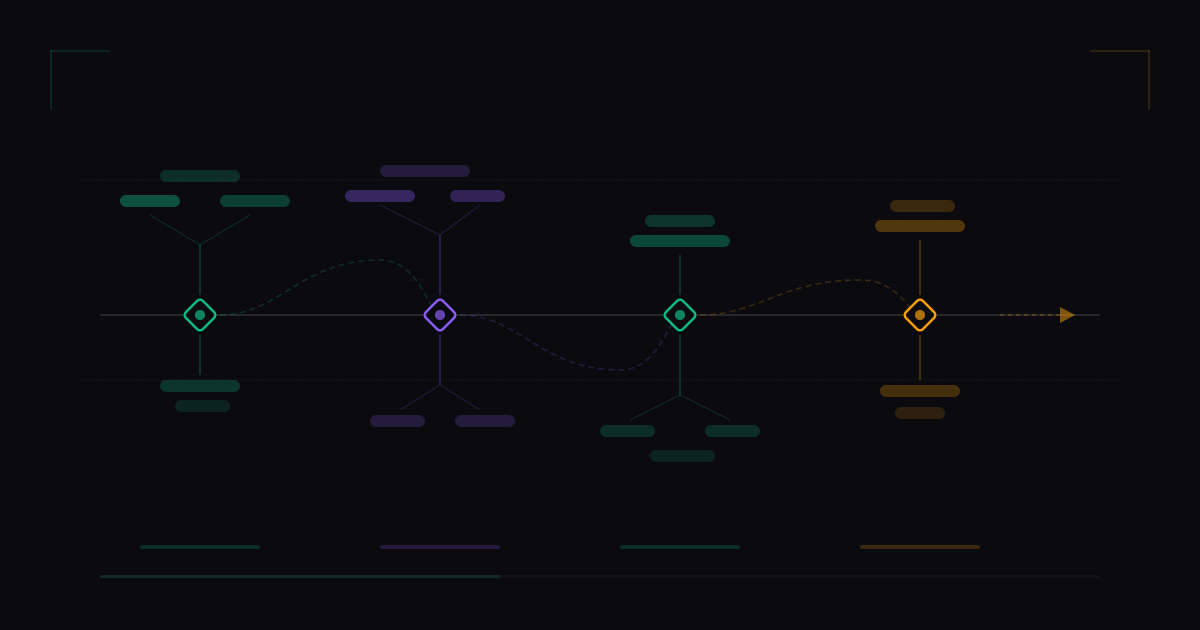
Every large organization today has some version of a data transformation roadmap. It usually lives inside a beautifully formatted PowerPoint deck, gets presented at an annual strategy offsite, earns head-nods from the executive committee, and then quietly disappears into a SharePoint folder nobody opens again. Six months later, the same leadership team is wondering why nothing has changed.
This is not an exaggeration. According to industry research, the majority of digital transformation initiatives fail to deliver their intended outcomes, and the root cause is rarely a lack of ambition or budget. It is almost always a failure of execution. The roadmap looked impressive, but it was never designed to be executed. It was designed to be presented.
If you are a VP of Data, a CDO, or a transformation lead, this guide will show you how to build a digital transformation roadmap that survives contact with reality, one that is structured, prioritized, sequenced, and most importantly, alive.
Why Most Transformation Roadmaps Fail
Before we build something better, we need to understand why the traditional approach keeps failing. There are three recurring patterns.
1. The roadmap is a deliverable, not a tool. A consulting firm comes in, runs a three-month diagnostic, and hands over a 150-slide deck. The deck contains a beautiful timeline graphic on slide 47. Everyone agrees it looks great. But nobody can actually use it to make decisions next Tuesday. The transformation execution plan is frozen in time the moment the engagement ends.
2. Initiatives are listed, not prioritized. Most roadmaps contain a flat list of 40 to 200 initiatives, loosely grouped by theme. There is no explicit ranking. There is no scoring methodology. There is no transparent rationale for why initiative A comes before initiative B. The result? Politics fills the vacuum. Whoever shouts loudest gets their project funded first, regardless of strategic value.
3. There is no feedback loop. A static document cannot learn. When market conditions change, when a key sponsor leaves, when a pilot fails, the roadmap does not adapt. Teams either ignore it and go rogue, or they keep executing a plan that no longer makes sense. Neither outcome is acceptable.
The fundamental problem is that most organizations treat their strategic roadmap data as a one-time output rather than a living, continuously updated instrument.
A good roadmap is not a poster on the wall. It is an operational system.
What a Good Transformation Roadmap Actually Looks Like
It is connected to a baseline assessment. You cannot plan a journey if you do not know where you are starting from. A credible data strategy roadmap begins with an honest evaluation of your current maturity, across data governance, infrastructure, analytics capabilities, talent, and culture. Without this baseline, every initiative is a guess. If you have not yet assessed your starting point, our readiness framework provides a structured way to do exactly that.
It is explicitly prioritized. Every initiative on the roadmap has a score based on transparent criteria: strategic impact, feasibility, cost, time to value, and risk. Stakeholders can see why a data catalog project is ranked above a machine learning platform, and they can challenge the inputs if they disagree. This eliminates the political maneuvering that plagues most transformation programs.
It is sequenced with dependencies. Prioritization tells you what matters most. Sequencing tells you what to do first. These are not the same thing. A high-priority initiative might depend on a foundational capability that must be delivered beforehand. For example, you cannot deploy an enterprise analytics platform if your data integration layer is still fragmented across 14 different ETL tools. A good roadmap maps these dependencies explicitly.
It has clear ownership and timelines. Every initiative has a named owner, a target start date, an estimated duration, and defined success criteria. Vague assignments like "IT will handle this" are a red flag. If nobody specific is accountable, the initiative will drift.
It is updated regularly. The roadmap is reviewed at least quarterly, ideally monthly. New information is incorporated. Completed initiatives are closed out. Blocked initiatives are escalated. Priorities are recalibrated based on what the organization has learned. This is what separates a living roadmap from a dead document.
Five Steps to Build a Transformation Roadmap That Works
Now let us get practical. Here is the step-by-step process for building a data transformation roadmap that will actually drive results in your organization.
Step 1: Assess Your Baseline Maturity
Before you define where you want to go, you need to know where you are. This means conducting a structured maturity assessment across your key transformation dimensions. For a data-focused transformation, these dimensions typically include governance, quality, architecture, analytics capabilities, literacy, and organizational readiness.
Do not make this a six-month project. A well-designed assessment can be completed in two to four weeks using a combination of stakeholder interviews, capability surveys, and documentation review. The goal is not perfection, it is a defensible snapshot of your current state that everyone agrees on.
Consider a practical example. A mid-sized retail company with 3,000 employees discovered through their baseline assessment that while their analytics team was relatively mature (scoring 3.5 out of 5), their data governance was almost nonexistent (scoring 1.2 out of 5). This single insight completely reshaped their roadmap. Instead of investing in advanced AI use cases, which had been the CEO’s pet project, they redirected the first 12 months toward foundational governance and data quality initiatives. The AI projects were not cancelled; they were properly sequenced to start once the data foundation could actually support them.
Step 2: Define Your Initiatives
With a clear baseline in hand, the next step is to define the specific initiatives that will close the gap between your current state and your target state. This is where most teams go wrong by either being too vague or too granular.
An initiative should be specific enough to be actionable but broad enough to represent a meaningful unit of work. "Improve data quality" is too vague. "Fix the null values in the customer_address field" is too granular. "Implement an enterprise data quality framework with automated profiling across the top 20 critical data domains" is about right.
For a typical enterprise transformation, expect 40 to 200 initiatives. A retail company we worked with identified 147 across data, digital, and AI workstreams. That sounds overwhelming, but it is manageable when each initiative has a clear scope, estimated effort, expected impact, and mapped dependencies.
Step 3: Prioritize with a Transparent Framework
This is the step that separates a serious transformation execution plan from a wish list. You need a scoring methodology that is transparent, repeatable, and defensible.
We recommend a multi-criteria scoring approach. For each initiative, evaluate and score across four to six dimensions. A common framework includes: Strategic Impact, Business Value, Feasibility, Time to Value, and Risk. Each dimension answers a specific question, how much does this advance the vision, what is the expected return, how realistic is delivery, how fast will we see results, and what could go wrong?
Each dimension gets a weight, and each initiative gets a score on each dimension. The weighted total produces a composite priority score. This is not rocket science, but it is remarkably rare.
The power of this approach is the conversation it forces. When a leader sees their favored project scored 47 while a governance initiative scored 82, the decision becomes evidence-based, not political. For more on this, see our guide on how to prioritize transformation initiatives.
Step 4: Sequence Into a Realistic Timeline
With your initiatives prioritized, you now need to arrange them on a timeline that respects three constraints: dependencies between initiatives, organizational capacity, and budget availability.
Start by mapping dependencies. You cannot build a customer 360 view until your CRM, ERP, and e-commerce data are integrated. You cannot train users on self-service analytics until the platform is deployed. These dependency chains create sequencing logic that may override raw priority scores.
Next, factor in capacity. Your organization probably cannot execute more than 5 to 8 initiatives concurrently. Overloading the portfolio is one of the most common causes of transformation failure. Better to execute 6 well than start 15 and finish none.
Finally, align with your budget cycle. A Q3-approved initiative that requires Q1 funding will stall before it begins. Sequencing must respect funding availability.
The output is a phased timeline, typically 18 to 36 months, with clear start and end dates, resource allocation, and milestone checkpoints. This is your how to build transformation roadmap answer in its most tangible form.
Step 5: Establish a Tracking and Adaptation Cadence
A roadmap without tracking is just a plan. And as the saying goes, no plan survives first contact with reality. You need a rhythm for reviewing progress, incorporating new information, and adjusting course.
We recommend a three-tier cadence. Monthly: Review initiative status, flag blockers, update completion percentages. This is operational. Quarterly: Reassess priorities, adjust sequencing based on what you have learned, incorporate new initiatives that have emerged, and retire initiatives that are no longer relevant. This is tactical. Annually: Refresh your baseline maturity assessment, evaluate the overall trajectory of your transformation, and recalibrate your long-term vision. This is strategic.
The quarterly review is the most important. New data flows in, an initiative was harder than expected, a regulatory change created urgency, a merger introduced 30 new data systems. The roadmap absorbs all of this and adjusts. It is not a failure to change the plan. It is a failure not to.
The quarterly review is where strategy becomes real. A roadmap that never changes is a roadmap nobody is using.
Choosing the Right View: Gantt, Timeline, or Kanban
One question that comes up frequently when building a digital transformation roadmap is how to visualize it. There are three common approaches, and each serves a different purpose.
Gantt charts are ideal for program managers who need granular control. They show durations, dependencies, and milestones on a time axis, but become overwhelming beyond 30 initiatives.
Timeline views are better for executive communication. A CDO presenting at a quarterly business review needs clarity, not complexity. Timeline views group initiatives by phase or workstream on a simplified horizontal axis.
Kanban boards are excellent for operational tracking. Initiatives move through columns like "Planned," "In Progress," "Blocked," and "Completed." If your "Blocked" column has more cards than "In Progress," you have a systemic problem that needs leadership attention.
The best approach is to use all three for different audiences. Your program managers live in the Gantt. Your executives see the timeline. Your teams use Kanban. The underlying strategic roadmap data is the same; only the presentation layer changes.
A Living Roadmap vs. a Static Document
This brings us to the most important distinction in transformation planning: the difference between a living roadmap and a static document.
A static document is a PDF or PowerPoint created at a point in time. The moment it is created, it begins to decay. Within three months, at least 20 percent of the content is outdated. Within six months, teams stop referencing it entirely.
A living roadmap is a continuously maintained system connected to real data, initiative status, resource utilization, budget consumption, maturity scores. It provides different views for different stakeholders, generates alerts when initiatives are at risk, and enables scenario planning: "What happens if we cut the budget by 15 percent?" or "What if we accelerate the data platform migration by three months?"
Organizations that maintain living roadmaps are dramatically more likely to achieve their transformation objectives because they are constantly course-correcting based on evidence rather than coasting on a plan that was obsolete before the ink dried.
This is why we built Fygurs. The platform turns your data strategy roadmap from a static deliverable into a living instrument, assessment, prioritization, sequencing, and tracking in one connected system. When something changes, your roadmap adapts.
How to Get Started
Here is the most practical advice we can offer: start small, but start structured.
You do not need to assess all 200 capabilities on day one. Pick one transformation dimension, data governance, analytics maturity, or digital customer experience, and run a focused assessment. Define the top 20 initiatives in that space. Score and prioritize them. Sequence the top 10 onto a 12-month timeline. Assign owners. Start the monthly tracking cadence.
This focused approach produces tangible results within one quarter, building executive confidence and creating a repeatable process you can scale. The retail company we mentioned earlier started with data governance alone. Within 18 months, they had expanded the methodology across all seven transformation dimensions, managing 147 initiatives with a clear, living roadmap.
Whether you use Fygurs or build your own system, the principles are the same. Assess honestly. Prioritize transparently. Sequence realistically. Track rigorously. And above all, keep the roadmap alive.
If you want to see how a purpose-built platform handles this end-to-end, explore our roadmap builder and see what a living data transformation roadmap looks like in practice.