If you asked ten executives in the same company how mature their data capabilities are, you would get ten different answers. The CDO would talk about data quality. The CTO would talk about infrastructure. The CFO would ask what maturity even means. And the CEO would say "we are data-driven" without being able to define what that actually looks like in practice.
This lack of shared understanding is not a communication problem. It is a strategic problem. When leadership cannot agree on where the organization stands today, it cannot agree on where to invest tomorrow. Maturity models exist to solve this exact problem: they give you a common language, a structured diagnostic, and a basis for prioritization.
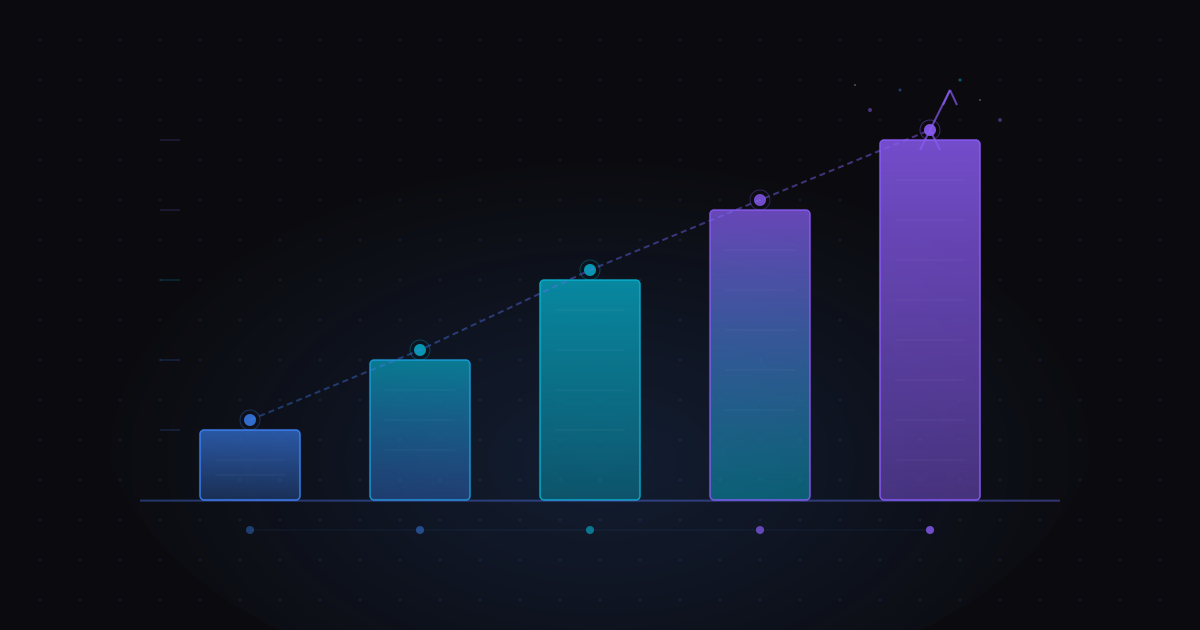
This article breaks down the five levels of data maturity, from Initial to Optimized. For each level, we describe the behaviors you will observe, the characteristics that define it, and real examples of what each stage looks like in practice. By the end, you should be able to place your organization, honestly, on the scale and understand what it takes to advance. If you want a formal assessment rather than a self-diagnosis, our Data & AI Readiness Framework provides a structured, multi-dimensional evaluation.
Why Maturity Levels Matter
Maturity is not an academic exercise. It is the foundation of every credible data strategy, investment decision, and transformation roadmap. Here is why it matters practically:
It prevents over-investment in the wrong areas. An organization at Level 1 that invests in a production machine learning platform is throwing money away. The infrastructure, governance, and talent prerequisites are not in place. Maturity assessment reveals these gaps before you commit budget.
It creates realistic expectations. Moving from Level 2 to Level 3 takes 12 to 18 months of deliberate effort for most organizations. Moving from Level 3 to Level 4 can take two to three years. Understanding this prevents the executive impatience that kills transformation programs prematurely.
It enables benchmarking. Your maturity level means little in isolation. A maturity score of Level 3 is excellent for a 200-person startup and concerning for a Fortune 500 financial institution. Benchmarking against peers provides the context that makes maturity actionable.
For a deeper exploration of how maturity assessments work and why they are the starting point for any data strategy, see our guide on what a data and AI maturity assessment is.
Level 1: Initial
What it looks like
At Level 1, data management is ad hoc, reactive, and individual-driven. There is no formal data strategy. Data exists in silos, departmental spreadsheets, individual laptops, disconnected databases. When someone needs data for a decision, they either already have it on their machine or they send an email asking someone else to extract it. The answer to "Where is our customer data?" depends on who you ask.
Characteristic behaviors
- Data is a byproduct of operations, not a strategic asset. No one is responsible for data quality.
- Reporting is manual and inconsistent. The same question generates different numbers depending on who answers it and which spreadsheet they pull from.
- No data governance exists. Access controls are either non-existent or applied haphazardly.
- Technology decisions are made by individual departments without coordination. Marketing uses one analytics tool, finance uses another, operations uses a third.
- Data requests take days or weeks because there is no self-service capability.
Real example
A 500-person manufacturing company has customer data in Salesforce, order data in an ERP, quality data in departmental Excel files, and supplier data in email attachments. When the CEO asks for a customer profitability report, the finance team spends two weeks manually merging data from four systems. The resulting report has known inaccuracies that everyone accepts because no better option exists.
How to know you are here
If your organization regularly makes decisions with data that different teams dispute, if no one owns data quality, and if the phrase "single source of truth" makes people laugh, you are at Level 1.
Level 2: Developing
What it looks like
At Level 2, the organization recognizes data as important and has started investing, but execution is inconsistent. There are pockets of excellence, a business intelligence team producing dashboards, a data engineer building pipelines, but these efforts are not coordinated across the organization. Some departments have better data practices than others, and there is no standard way of doing things.
Characteristic behaviors
- A basic BI or analytics team exists, usually sitting within IT or finance. They produce reports and dashboards, but adoption is uneven.
- Some data quality processes exist, but they are reactive, problems are fixed when discovered, not prevented by design.
- A data warehouse or equivalent exists, but it is incomplete. Critical data sources are still missing or poorly integrated.
- Conversations about data strategy are happening, but no formal strategy document exists. Data investment decisions are made project by project, not portfolio by portfolio.
- Leadership is aware that data matters but does not yet have the vocabulary or metrics to assess their organization's capability.
Real example
A mid-size retail company has invested in a cloud data warehouse and a BI platform. The marketing team has good dashboards tracking campaign performance. But the operations team still relies on weekly Excel exports from the ERP. Customer data in the warehouse does not match Salesforce because no reconciliation process exists. The company hired its first "Head of Data" six months ago, but the role has no budget, no team, and no executive mandate.
How to know you are here
If you have some analytics capability but it depends on individual heroes rather than organizational processes, if data quality is sometimes good and sometimes terrible depending on the domain, and if the phrase "we need a data strategy" is spoken regularly but nothing has been formalized, you are at Level 2.
The Level 2 trap
This is the most dangerous level because it feels like progress. Dashboards exist. Some decisions are data-informed. But the lack of standardization means the organization cannot scale its data capabilities. Every new use case requires custom work. Every new hire has to learn a different system. Many organizations spend years at Level 2, convinced they are making progress because they keep shipping dashboards, when what they actually need is the organizational infrastructure to move to Level 3.
Level 3: Defined
What it looks like
Level 3 is the turning point. The organization has moved from ad hoc data practices to standardized, documented processes with clear ownership. A formal data strategy exists and has executive sponsorship. Data governance is not just a concept, it has named owners, published policies, and regular review cadences. The organization can articulate what data it has, who owns it, and how it should be used.
Characteristic behaviors
- A formal data strategy exists, approved by the executive team, and reviewed at least annually.
- Data governance is operational: data owners are appointed, stewards are active, quality standards are defined and measured.
- A centralized data platform exists (data warehouse, data lake, or lakehouse) with most critical data sources integrated.
- Self-service analytics is available, and adoption is growing. Business users can access dashboards and explore data without filing a request to the data team.
- Data literacy programs exist, even if adoption is still early. The organization recognizes that technology without skills is insufficient.
- Data investment decisions are made at the portfolio level, not project by project.
Real example
A financial services company with 3,000 employees has a CDO who reports to the CEO. The CDO oversees a data governance program with stewards in each business line (retail, commercial, wealth, operations). A cloud-based data lakehouse integrates data from 15 source systems. Self-service BI adoption is at 45% and growing. Data quality is measured weekly across four dimensions, and quality scores are included in the monthly executive dashboard. The data strategy is a 20-page document that was debated, approved, and is reviewed quarterly.
How to know you are here
If you have formal governance with named roles, a data platform that most of the organization uses, a documented strategy with executive buy-in, and data quality that is measured (not just discussed), you are at Level 3. The test is whether data practices would survive the departure of any single individual, if they would, your processes are truly defined rather than personality-dependent.
Level 4: Managed
What it looks like
At Level 4, data capabilities are measured, monitored, and continuously optimized. The organization does not just have data processes, it has metrics about those processes. Data quality is tracked quantitatively and tied to business outcomes. Data investment is justified by demonstrated ROI, not projected ROI. Decision-making across the organization is data-driven as the default, not the exception.
Characteristic behaviors
- Data quality is monitored in real time with automated alerting. Quality issues are caught and resolved before they impact downstream consumers.
- Data operations have SLAs: pipeline reliability, data freshness, query performance, and incident response times are all tracked and managed.
- Advanced analytics and predictive models are in production, delivering measurable business value. The organization has moved beyond descriptive analytics (what happened) to predictive analytics (what will happen).
- Data ROI is quantified. Leadership can answer the question "What is the return on our data investment?" with actual numbers.
- Cross-functional data collaboration is standard. Data teams work embedded within business units, not isolated in a central function.
- Data culture is strong: non-technical leaders regularly use data in their decision-making and can articulate why specific metrics matter.
Real example
A large insurance company has automated data quality monitoring across all critical domains. Data quality dashboards are reviewed weekly by domain stewards and monthly by the executive committee. Predictive models for claims fraud detection and customer churn are in production, generating estimated annual savings of 12 million euros. The data team tracks its own productivity metrics: time to deploy new data products, pipeline reliability (99.5% SLA), and internal customer satisfaction scores. Data investment proposals require quantified business cases and are evaluated against past performance of similar initiatives.
How to know you are here
If your organization measures data quality in real time, has predictive or prescriptive analytics in production, can quantify the ROI of its data investments, and treats data-driven decision-making as the norm rather than the aspiration, you are at Level 4.
Level 5: Optimized
What it looks like
Level 5 organizations are at the leading edge. Data and AI are not just capabilities, they are embedded in the operating model of every function. Continuous improvement is systematic, not aspirational. Innovation is part of the culture, with structured processes for experimentation, learning, and scaling successful experiments. These organizations do not just use data well, they use data to reinvent how they compete.
Characteristic behaviors
- AI and ML are embedded in core business processes: automated decision-making, intelligent automation, real-time personalization.
- Data mesh or federated data architectures distribute data ownership and capabilities across domains while maintaining enterprise governance.
- Continuous improvement is systematic: maturity is reassessed regularly, processes are optimized based on quantitative evidence, and investments are adjusted dynamically.
- Innovation culture is structured: the organization has formal processes for experimentation, with dedicated budgets for exploring emerging technologies and use cases.
- External data integration enriches internal data assets: market data, social data, satellite data, or other external sources are systematically incorporated into analytics and decision-making.
- The organization is a recognized industry leader in data and AI practices, contributing to standards bodies, publishing research, or serving as a benchmark for peers.
Real example
A global e-commerce company has ML models embedded in every customer touchpoint: personalized recommendations, dynamic pricing, automated customer service, fraud detection, supply chain optimization. A data mesh architecture gives each product team ownership of their data domain while a platform team provides shared infrastructure. The company runs over 1,000 A/B tests per quarter, with automated systems to detect winners and roll out changes. The data team does not just support the business, it is the business. Data capabilities are a core competitive advantage cited in investor presentations.
How to know you are here
Very few organizations genuinely operate at Level 5 across all dimensions. If AI and ML are embedded in core business processes (not just proof-of-concept), if continuous improvement is driven by quantitative evidence rather than intuition, and if data is recognized as a competitive differentiator in your market positioning, you may be at Level 5. The honest test: are your data capabilities something competitors are trying to replicate?
Important caveat: Level 5 is not the goal for every organization. A 200-person B2B SaaS company does not need the same data sophistication as a global financial institution. The right target maturity depends on your industry, competitive context, regulatory requirements, and strategic ambitions. The framework helps you understand where you are relative to where you need to be, not where some abstract ideal says you should be.
How to Move Between Levels
Understanding the levels is useful. Understanding how to advance is essential. Here are the transitions that matter and what they require.
Level 1 to Level 2: Start somewhere
The transition from Initial to Developing requires a single catalytic investment: one analytics capability that proves the value of data to the organization. This might be a BI platform, a first data hire, or a single high-impact dashboard that changes how leadership sees information. The goal is not to build a complete data function, it is to create enough momentum that the organization wants more.
Level 2 to Level 3: The hardest transition
Moving from Developing to Defined is the most difficult transition in the maturity model. It requires formalizing what was previously informal: creating a data strategy document, establishing governance with named roles and accountability, building a centralized platform, and investing in data literacy. This transition is hard because it requires organizational change, not just technology change. It means telling teams that their departmental spreadsheets are no longer acceptable, that data quality is now someone's formal responsibility, and that investment decisions will be made centrally. Expect cultural resistance and plan for it.
Level 3 to Level 4: Measure everything
The transition from Defined to Managed is about measurement and optimization. You already have the processes, now you need the metrics to prove they are working and the discipline to improve them continuously. This requires investing in monitoring and observability for your data platform, building business cases that quantify data ROI, moving from descriptive to predictive analytics, and creating feedback loops between data outcomes and strategy.
Level 4 to Level 5: Embed and innovate
The transition to Optimized requires embedding data and AI into the core operating model. This is not a data team initiative, it is an organizational transformation that touches every function. It requires executive leadership that sees data as a competitive weapon, not just an operational tool. Few organizations make this transition deliberately; most that reach Level 5 do so because their industry or competitive context demands it.
Assessing Your Organization
Self-assessment is a starting point, but it has limitations. Leaders tend to overestimate their organization's maturity because they see the best pockets of practice and generalize. A structured, multi-dimensional assessment produces a more accurate and actionable picture.
Our Data & AI Readiness Framework assesses maturity across six dimensions, not just one. This matters because organizations are rarely at the same level across all dimensions. You might be Level 3 on Data Infrastructure but Level 1 on Organization and Talent. That imbalance is precisely the insight that drives effective prioritization.
Whether you use our framework or build your own assessment process, the principle is the same: measure before you invest, benchmark before you plan, and reassess before you declare victory. Maturity is not a destination. It is a continuous diagnostic that keeps your data strategy honest and your investments productive.