Product discovery is supposed to reduce uncertainty. But most discovery processes are episodic: a team conducts user interviews before a major initiative, runs a design sprint when launching a new feature, or surveys customers when renewal rates drop. These point-in-time efforts produce valuable insights, but they leave gaps between cycles. Between discovery efforts, teams make decisions based on stale data, outdated assumptions, or pure intuition.
Continuous assessment changes this dynamic. Instead of treating discovery as a periodic project, continuous assessment builds an ongoing stream of organizational and maturity data that informs product decisions in real time. The result is a discovery practice that is always on, always learning, and always reducing the uncertainty that product decisions require.
This article explores how continuous maturity assessment transforms product discovery, with practical guidance on implementation and integration with existing product management workflows.
The Problem with Episodic Discovery
Traditional product discovery operates in cycles. A team identifies a problem space, conducts research (interviews, surveys, competitive analysis), synthesizes findings, generates hypotheses, and then shifts to delivery mode. Discovery is treated as a phase that precedes development, not a continuous practice that runs alongside it.
This episodic model has three fundamental problems.
Problem 1: Data Decay
The insights from a discovery cycle have a shelf life. Customer needs evolve. Market conditions change. Competitive landscapes shift. The findings from a discovery effort conducted six months ago may be partially or wholly obsolete by the time the team uses them to make decisions. In fast-moving markets, even three months is enough for discovery data to degrade significantly.
Problem 2: Blind Spots Between Cycles
Between discovery cycles, the product team makes decisions without the benefit of fresh research. These decisions are not random, as teams bring accumulated knowledge and judgment, but they are not evidence-based in the way discovery-informed decisions are. Important signals get missed because nobody is actively looking for them.
Problem 3: Discovery Bias
When discovery is episodic, teams tend to focus their research on the specific problem they already intend to solve. This creates confirmation bias: the discovery process validates the predetermined direction rather than genuinely exploring the problem space. True discovery should be open-ended enough to surface unexpected opportunities, but episodic models rarely allow for that breadth.
What Continuous Assessment Looks Like
Continuous assessment replaces the episodic model with an ongoing data collection and analysis practice. Instead of conducting a maturity assessment once a year and then filing the results, the organization assesses regularly, tracks trends over time, and uses the evolving data to inform product decisions continuously.
The Core Loop
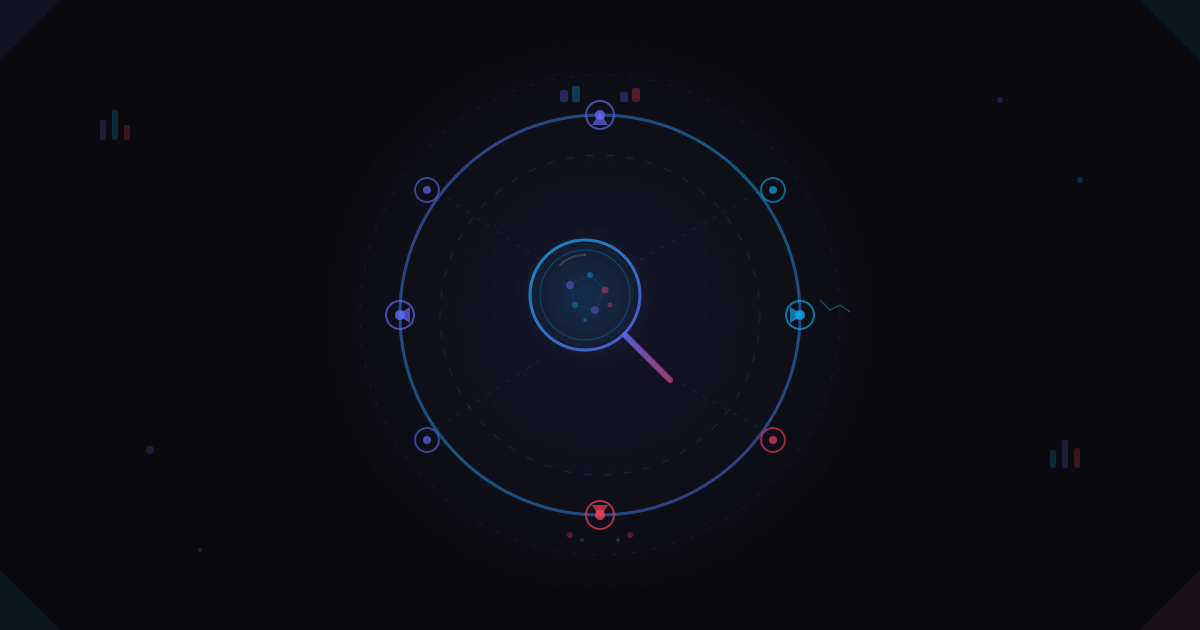
The continuous assessment loop has four stages:
1. Assess: Collect structured data about organizational maturity across key dimensions: data infrastructure, process maturity, skill development, technology adoption, and strategic alignment. This assessment is designed to be lightweight enough to run monthly or quarterly without creating fatigue.
2. Analyze: Compare current assessment results against previous results, industry benchmarks, and strategic targets. Identify trends: what is improving, what is stagnating, and what is declining? Surface the gaps between current state and target state.
3. Generate: Based on identified gaps and trends, generate candidate initiatives and opportunities. These are not just problems to fix but opportunities to exploit. A rising maturity score in data engineering, combined with a stagnant score in analytics adoption, might surface an opportunity to build self-serve analytics tools that the organization is now ready to adopt.
4. Prioritize: Score the generated initiatives using RICE scoring or another prioritization framework, incorporating the maturity data as an input to confidence and effort estimates. Feed the prioritized initiatives into the product roadmap.
This loop runs continuously, with each iteration producing fresher data, sharper insights, and more precisely targeted initiatives.
How Continuous Assessment Improves Product Decisions
Better Problem Identification
Episodic discovery identifies the problems you already suspect exist. Continuous assessment surfaces problems you did not know about. When maturity data shows that data governance scores have declined across three consecutive assessments, that is a signal that a new problem has emerged, even if no stakeholder has raised it. The data speaks before the complaints arrive.
This early problem identification is particularly valuable for product leaders managing transformation programs. The Data & AI Readiness Framework is designed specifically to surface these emerging gaps before they become blocking issues.
Improved Confidence in Prioritization
One of the most challenging dimensions in any prioritization framework is confidence. How certain are you that this initiative will deliver the expected impact? Continuous assessment data directly improves confidence estimates by providing current evidence about organizational readiness, skill levels, and adoption patterns.
When an initiative's confidence score is based on last month's maturity assessment rather than last year's consulting report, the entire prioritization becomes more reliable. The initiatives that rise to the top of the ranking are more likely to succeed because the readiness data underpinning their scores is fresh.
Faster Validation of Hypotheses
Product teams generate hypotheses constantly. "If we build this feature, adoption will increase." "If we improve this process, efficiency will improve." Continuous assessment provides the data infrastructure to validate these hypotheses quickly.
When you build a new feature intended to improve data governance maturity, the next assessment cycle will show whether governance scores actually improved. If they did not, you have fast feedback that the feature did not achieve its intended outcome, and you can iterate before investing further. This tight feedback loop is the essence of evidence-based product development.
Reduced Discovery Waste
Episodic discovery often produces research that is never acted upon. The team spends two weeks on discovery, produces a comprehensive report, and then organizational priorities shift, leaving the research unused. Continuous assessment reduces this waste because the insights are generated incrementally and fed directly into the prioritization workflow. There is no big research project to shelve; there is a steady stream of small, actionable insights.
The shift from episodic to continuous discovery is not just a process change. It is a mindset change. Instead of treating discovery as a project with a start and end date, you treat it as a persistent capability that the product team can draw on at any time.
Implementing Continuous Assessment
Start With a Baseline
Before you can track trends, you need a starting point. Conduct a comprehensive maturity assessment across all relevant dimensions. This baseline assessment should be thorough enough to establish reliable scores but not so burdensome that it discourages future participation.
At Fygurs, the baseline assessment takes approximately 15 minutes per stakeholder and covers six core dimensions of digital transformation readiness. The speed matters because the entire value proposition of continuous assessment depends on the willingness of participants to reassess regularly.
Define Assessment Cadence
The right cadence depends on your organizational context. Monthly assessments work well for fast-moving organizations or teams in the middle of major transformation programs. Quarterly assessments are appropriate for more stable environments. Annual assessments are too infrequent for continuous discovery but may be appropriate for compliance or benchmarking purposes.
We recommend starting with quarterly assessments and increasing frequency if the data proves valuable and the assessment burden is manageable.
Integrate With Product Workflows
Assessment data is only valuable if it reaches the people making product decisions. Integrate assessment results into your existing product management workflows:
Strategy reviews: Present maturity trend data in quarterly strategy reviews. Show which capability areas are improving and which are falling behind. Use this data to validate or adjust strategic priorities.
Prioritization sessions: Use current maturity scores as inputs to confidence and effort estimates in feature prioritization. An initiative that requires high data engineering maturity should have a lower confidence score if the latest assessment shows data engineering maturity is declining.
Roadmap planning: Generate candidate initiatives directly from assessment gaps. When the assessment reveals a significant gap between current and target maturity in a specific area, that gap becomes a candidate initiative for the product roadmap.
OKR setting: Use maturity targets as Key Results in your OKR framework. "Improve data governance maturity from Level 2 to Level 3" is a measurable, outcome-oriented Key Result that connects organizational capability development to product team goals.
Build Trend Analysis Capabilities
The real power of continuous assessment is in the trends, not the individual scores. A maturity score of 3.2 out of 5 tells you relatively little. A trend showing that the score has improved from 2.1 to 3.2 over three quarters tells you the organization is developing capability in this area. A trend showing the score declining from 3.5 to 3.2 tells you something is going wrong that needs investigation.
Invest in visualizing maturity trends over time, across dimensions, and across organizational units. These trend views become the primary input to continuous discovery, replacing point-in-time research reports with living dashboards that evolve with the organization.
Continuous Assessment and Product-Led Growth
For product leaders building products that serve transformation professionals, continuous assessment creates a powerful product-led growth loop.
Users complete an assessment and receive immediate value: a maturity snapshot with benchmarks and recommendations. This drives activation. As they complete subsequent assessments, they build trend data that becomes increasingly valuable. This drives engagement and retention, as the value of the product compounds over time.
The assessment data also informs the product's own development. Aggregate patterns across assessments reveal common maturity gaps, emerging trends, and unmet needs. These patterns become inputs to product discovery, creating a cycle where the product improves based on the data its users generate.
This is the essence of continuous assessment as a product strategy: the assessment is both the product's core value proposition and its primary discovery mechanism. For more on how PLG metrics connect to this approach, see our guide on what to track and why.
Common Implementation Challenges
Challenge 1: Assessment Fatigue
If assessments are too long or too frequent, participants stop completing them, and the entire system breaks down. The solution is to keep individual assessments short (under 15 minutes), make the results immediately valuable to participants (not just to the product team), and vary the assessment focus across cycles so participants are not answering the same questions every time.
Challenge 2: Data Quality
Self-reported maturity data has inherent biases. People tend to overestimate their own capabilities and underestimate gaps. The solution is to use structured rubrics with clear level definitions that reduce subjectivity, to triangulate self-assessments with objective metrics where possible, and to focus on trends rather than absolute scores (the biases tend to be consistent across assessments, so trends are more reliable than individual scores).
Challenge 3: Organizational Buy-In
Continuous assessment requires ongoing participation from people across the organization. If leadership does not visibly support and use the assessment data, participation will decline over time. The solution is to make the assessment results visible in decision-making. When the leadership team explicitly references maturity data in strategy discussions, participants see that their input matters, and participation sustains itself.
Continuous assessment is not a tool you deploy once. It is a practice you cultivate. The organizations that get the most value from it are the ones that embed it in their decision-making rhythm, not the ones that deploy the most sophisticated assessment technology.
The Discovery Advantage
Product teams that practice continuous assessment have a structural advantage in product discovery. They identify problems earlier, validate hypotheses faster, prioritize with more confidence, and waste less effort on discovery that never gets used.
This advantage compounds over time. Each assessment cycle adds to the historical dataset, making trend analysis more reliable and gap identification more precise. After four quarters of continuous assessment, the product team has a rich, longitudinal view of organizational maturity that no episodic research effort could replicate.
The result is better products built on better evidence. Not perfect products, as no discovery process eliminates uncertainty entirely, but products that are consistently more aligned with organizational needs and more likely to deliver their intended outcomes.
If your product team is ready to shift from episodic to continuous discovery, explore how Fygurs makes maturity assessment fast, repeatable, and directly connected to product decisions. The assessment is the discovery. The discovery drives the roadmap. And the roadmap delivers the outcomes.